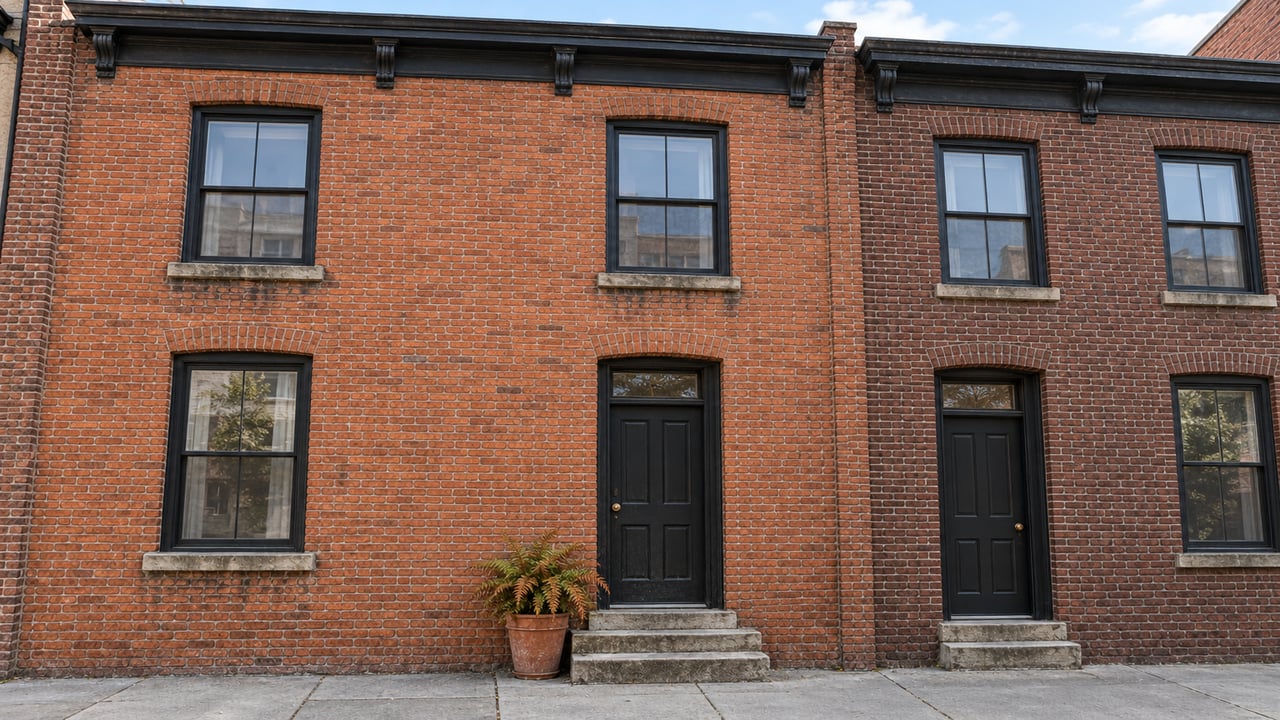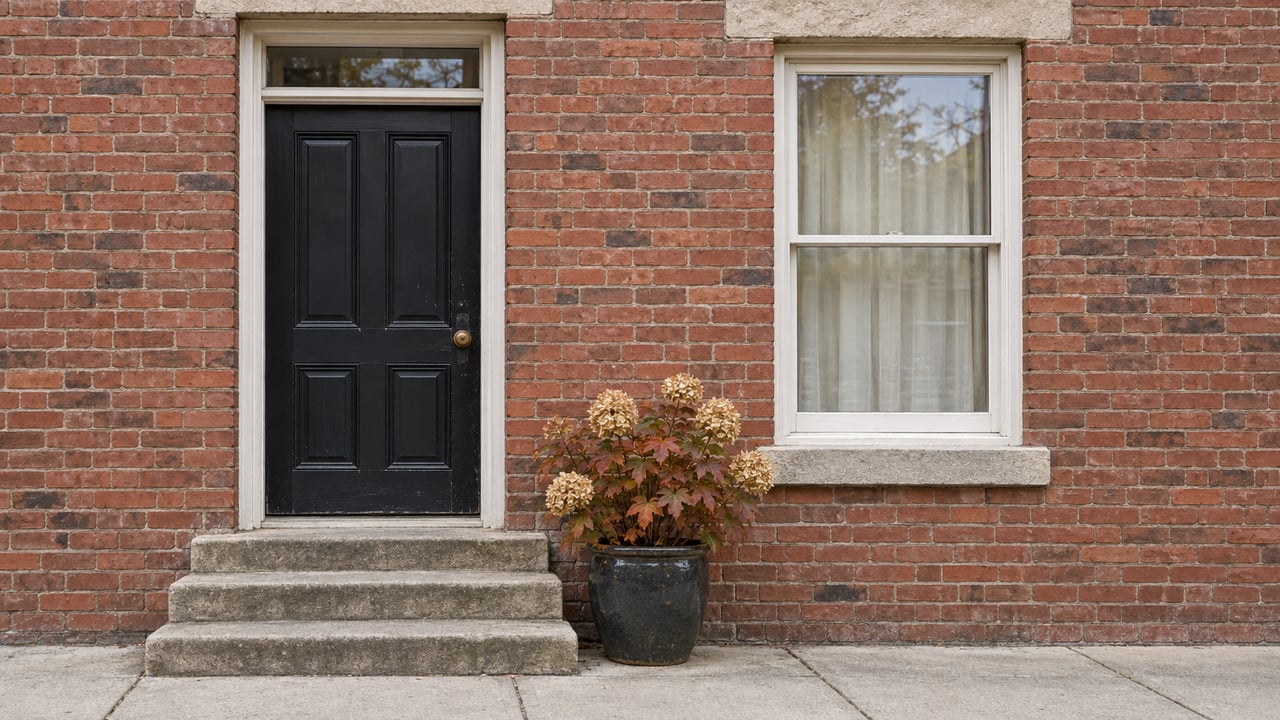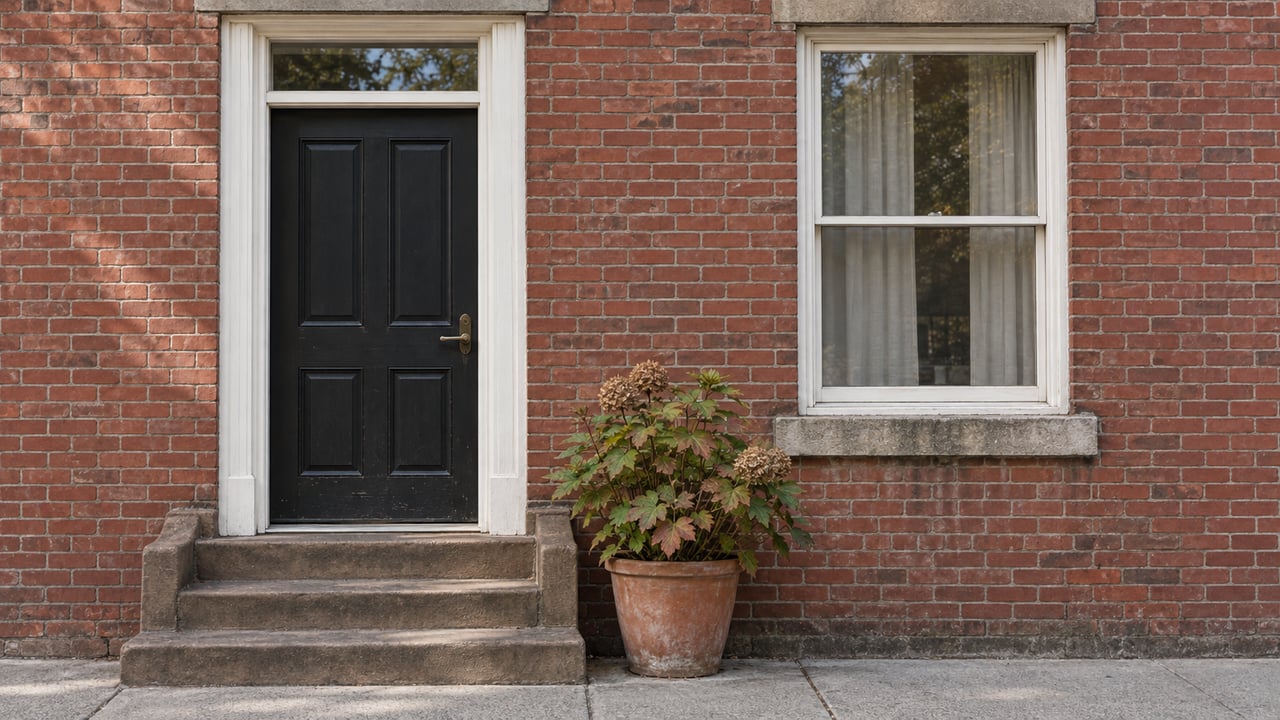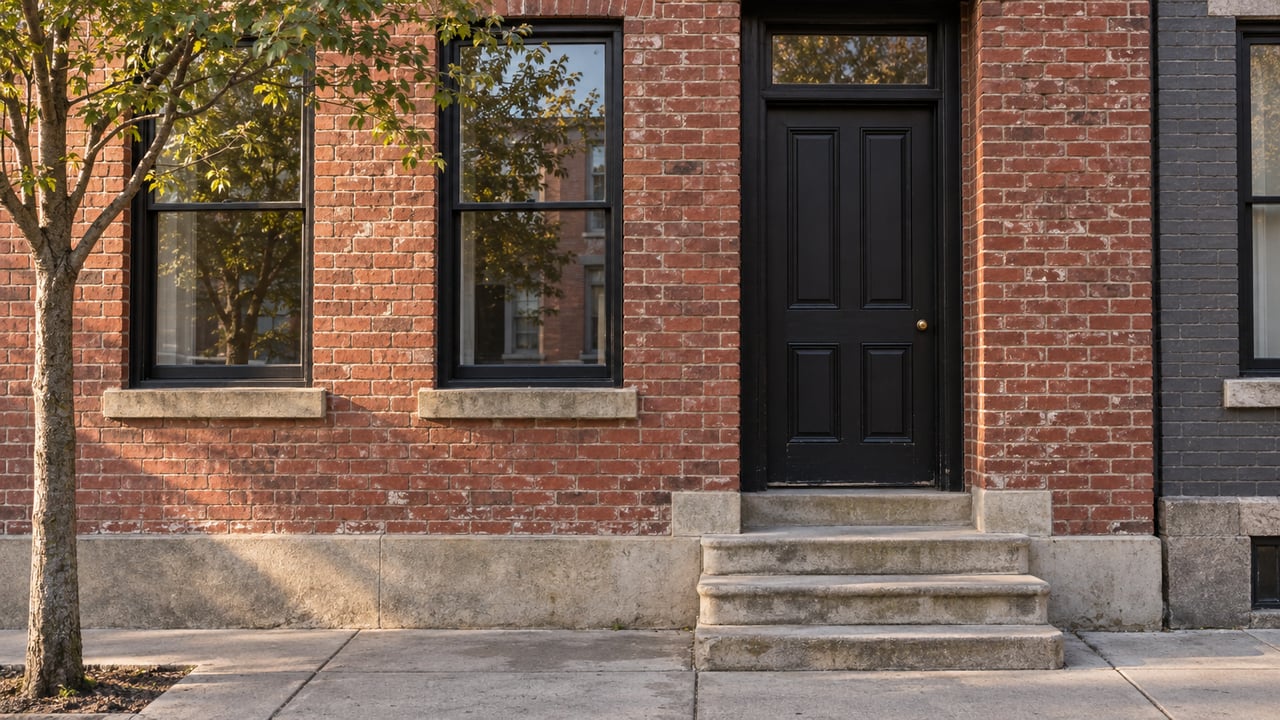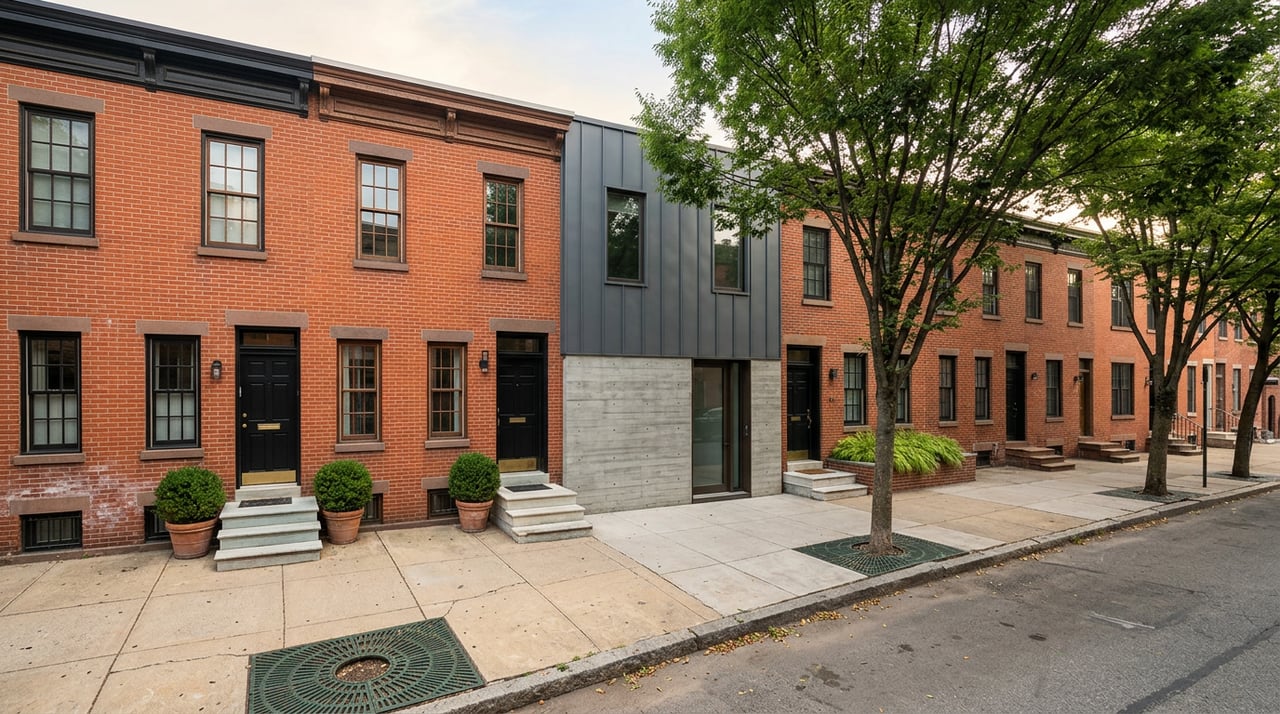
Walk any block between Fitzwater and Federal and you can read the last fifteen years of Philadelphia policy off the facades. A 1905 two-story with a bracketed cornice sits shoulder to shoulder with a 2019 four-story infill in charcoal fiber cement. The party wall between them is the same masonry it was in 1905. The tax bills on the two houses are not remotely the same. And when the older one goes on the market, both of those facts show up in the inspection response and the counter.
That is the setting for almost every Graduate Hospital resale in 2026. It is also why the neighborhood produces its own distinct list of things that trip up a sale.
The two items sellers most often treat as background detail here — the party wall and the permit-issue date on the abatement — are the two line items most likely to move price at contract.
Everything below builds that case.
1. The party wall is the negotiation, not the paint
Graduate Hospital was, in the words of Inquirer critic Inga Saffron, "transformed as radically" as any neighborhood in the city by the 10-year abatement. That transformation happened one lot at a time. It also happened next to your foundation.
Philadelphia inspectors treat the party wall as a shared structural asset that neither owner fully controls. They look for diagonal cracking at window frames, bulging masonry, moisture staining at the parapet, and settlement differentials between the two roof lines. What they cannot do is assess the neighbor's side of the wall. When the neighbor's side is a 2018 build whose contractor underpinned the foundation to lower a basement, that limitation matters.
City rules require written notice to adjoining owners and a licensed special-inspections engineer on site during underpinning of a party wall, per the Philadelphia Department of Licenses and Inspections' Construction Next Door guidance. Notice requirements apply to permit applications filed on or after January 1, 2023. That means many of the underpinning jobs done during the 2015 to 2022 boom happened without the paper trail a current seller might wish existed.
The practical consequence for a seller today:
- If your basement wall has hairline cracks that appeared during the neighbor's build, expect the buyer's inspector to flag them and request a structural engineer's review.
- If a prior owner filed a party-wall repair, keep the invoice. Community Legal Services still runs a Rowhouse Protection Project documenting cases where adjacent construction damaged attached homes, and buyers' agents know to ask.
- If you renovated and the work touched the shared wall, disclose it. Pennsylvania's Seller Property Disclosure Statement expects it, and a paper trail actually helps you.
The move is to walk the wall with a general inspector or structural engineer before you list, not after the offer.
2. Disclosure is not a form. It is a two-year liability window.
Pennsylvania's Real Estate Seller Disclosure Law, 68 Pa.C.S. § 7301 et seq., governs disclosure for any transfer of a property with one to four residential units. The Pennsylvania Association of Realtors' Form SPD is the version most Graduate Hospital sellers will fill out. The form has to be delivered before the agreement of sale is signed.
Two things about that form are worth stating plainly, because they are consistently misunderstood by first-time sellers here.
"Material defect" has a definition. Under the statute, it is a problem that would have a "significant adverse impact on the value of the property or that involves an unreasonable risk to people on the property." A structural element at or beyond the end of its normal useful life is not, by itself, a material defect. A 20-year-old flat roof is not automatically a disclosure item. A 20-year-old flat roof with two active leaks and a patch you paid a roofer to install in 2023 is.
"Unknown" is not a safe answer. If a defect is one that someone living in the home should have noticed, checking "Unknown" can backfire in litigation. Buyers have up to two years after settlement to bring a claim under the disclosure law. Sellers with construction, engineering, or architectural expertise are held to a higher standard, per 68 Pa.C.S. § 7304.
The categories that come up most often in Graduate Hospital rowhome sales:
| Disclosure area | Typical Graduate Hospital finding |
|---|---|
| Basement water | Poured concrete or stone foundations, not waterproofed to modern standards |
| Roof | Flat or low-slope EPDM, modified bitumen, or built-up asphalt; 15–25 year life |
| Electrical | Knob-and-tube still energized in pre-1940 stock, sometimes behind newer insulation |
| Plumbing supply | Lead service line from the street; cast iron drains near end of life |
| Sewer | Original clay lateral with root intrusion or bellied sections |
| Environmental | Lead paint in pre-1978 stock; asbestos in 9×9 floor tiles and pipe wrap |
| Structure | Party-wall cracks, settlement between adjoining properties |
There is no exception on the disclosure form for flippers, landlords who never occupied the home, or sellers using a power of attorney. That is worth repeating because agents field the question weekly.
3. The abatement is a line item now, not a bonus
This is the friction that gets missed most often, and it is the one that most cleanly favors sellers who understand it.
Philadelphia's 10-year residential tax abatement does not reset on sale. A buyer picks up the remaining years and nothing more. That was true under the old rules and remains true under the new ones. What changed on January 1, 2022 is the schedule.
| Permit issue date | Abatement schedule |
|---|---|
| Before Jan 1, 2022 | 100% of improvement value abated for the full 10 years |
| On or after Jan 1, 2022 | Year 1: 100%. Then declines 10 points per year (90/80/70/60/50/40/30/20/10) |
Two things follow from that table for a Graduate Hospital seller:
The permit-issue date is the value driver, not the year built. A house whose building permit was pulled in December 2021 and finished in 2023 is under the old flat abatement. A cosmetically identical house whose permit was pulled in February 2022 is on the declining schedule. Buyers' agents know how to check. Pull the permit history from Atlas before listing so the number is not a surprise mid-negotiation.
Remaining years compress fast. A property with eight years left on a pre-2022 flat abatement is priced meaningfully differently than a comparable home with one year left, because the buyer's monthly carrying cost is different for the next 96 months. At the current city and school district rate of 1.3998% of assessed value, the difference on a $700,000 improvement value is roughly $9,800 per year of abatement remaining. That is real money in an offer.
A related detail worth knowing before you list: a property with an active abatement is not eligible for the Homestead Exemption. If your buyer plans to owner-occupy, the Homestead Exemption becomes available the year after the abatement expires. Sophisticated buyers model both curves.
Graduate Hospital's new-construction resale pool is thin enough that individual listings move the comps. In April 2026 there were roughly three active new-construction listings at a median list of about $1.85 million and $547 per square foot. The broader neighborhood median sale sat at $604,050 in February 2026 and $633,300 in March 2026 per Redfin's snapshots, with days on market around 75 and a sale-to-list ratio near 99%. Balanced but not sleepy. In this kind of market, a clear abatement story is worth more than a staged closet.
A pre-list checklist for a Graduate Hospital rowhome
- Pull permits, violations, and lien history on your address from Atlas and the OPA's records. Clear anything open.
- Walk the party walls with a structural engineer if there is any visible cracking, especially on blocks with recent infill.
- Confirm the roof's age and last service. Get a written condition report if the membrane is over 15 years old.
- Scope the sewer lateral. A clay-lateral belly is cheaper to negotiate before you have an offer than after.
- If you have an abatement, print the OPA record showing the permit-issue date and remaining years. Put it in the disclosure packet.
- Complete Form SPD with an agent who has closed in the neighborhood. "Unknown" answers get a second look.
- Keep every invoice from work done during your ownership. Two years of post-closing liability is a long time.
FAQ
Do I have to disclose adjacent construction that damaged my party wall if the damage was repaired? Repaired damage is still a known condition. Disclose the event, the repair, and the contractor. The buyer will find the repair anyway during inspection, and a documented fix reads better than a discovered surprise.
If I never lived in the property, do I still fill out the disclosure? Yes. Pennsylvania's disclosure law has no exception for investors, flippers, or landlords who never occupied the home. The only broad exception for new construction requires the buyer to receive a one-year warranty and the building to have been inspected for code compliance.
Can I sell "as-is" and skip disclosure? No. All Pennsylvania property is sold as-is unless the parties agree otherwise, and that phrase does not remove the seller's duty to disclose known material defects. Lender or L&I safety repairs may still be required to close.
How do I confirm my abatement's remaining years? Look up the parcel at phila.gov or contact the Office of Property Assessment's Abatement Unit at 601 Walnut Street, Suite 300 W. The record will show the permit-issue date and the exempt improvement value each year.
If you own in Graduate Hospital and are thinking about listing in the next twelve months, the friction points above are worth walking your block for before you interview agents. The Stawasz Group is happy to sit down and read your specific house — permits, party walls, and abatement math included — before you commit to a price. Contact us when you are ready.